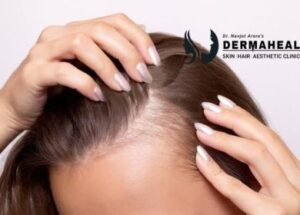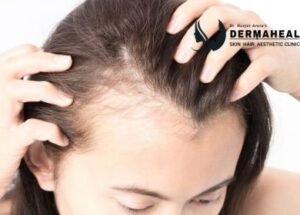


Hair loss can start gradually. You may first notice more hair on your pillow, a widening hair part, a receding hairline, a thinner crown, or reduced overall hair density. Once hair loss becomes noticeable, a common question is: Should I choose PRP, GFC, or a hair transplant?
The answer depends on the cause and stage of your hair loss.
PRP and GFC are non-surgical regenerative approaches that may be considered when active hair follicles are still present. A hair transplant is a surgical hair restoration procedure that moves healthy follicles from a donor area to areas affected by significant thinning or baldness.
If you are searching for hair loss treatment in Delhi, it is important to understand the difference between these options before choosing a procedure.
A dermatologist can assess your scalp, identify the type of hair loss, and explain which treatment options may be appropriate for your condition.
PRP, GFC or Hair Transplant: What Is the Difference?
In simple terms:
- PRP/GFC: Used to support existing hair follicles and may be considered for early to moderate thinning.
- Hair transplant: Moves healthy follicles to areas where significant hair loss has occurred.
- Medical hair-loss treatment: May be needed alongside or before procedures, depending on the cause.
The American Academy of Dermatology notes that different types of hair loss require different treatments. A dermatologist can help identify the cause before recommending an appropriate treatment plan.
At Dermaheal Skin & Hair Clinic, the current hair-loss programme begins with trichoscopy, scalp examination and medical history before treatment is selected.
What Is PRP Hair Treatment?
PRP stands for Platelet-Rich Plasma.
During PRP treatment, a small amount of your blood is collected and processed to separate the plasma containing concentrated platelets. The prepared plasma is then injected into selected areas of the scalp.
The aim is to support existing hair follicles, reduce shedding and improve hair density.
The American Academy of Dermatology describes PRP as one procedure that may be included in a dermatologist’s hair-loss treatment plan.
At Dermaheal, Hair GFC (PRP) is described as a non-surgical treatment using growth factors from the patient’s own blood. The clinic lists it for concerns such as diffuse thinning, female pattern hair loss, early male pattern baldness, post-pregnancy hair fall and stress-related shedding, subject to individual assessment.
When May PRP Be Considered?
PRP may be considered when:
- Hair is thinning but follicles are still active.
- You have diffuse hair thinning.
- Hair density has started decreasing.
- You are experiencing certain types of ongoing hair shedding.
- You want a non-surgical treatment option.
PRP does not replace a diagnosis. The underlying cause of hair loss should be assessed first.
What Is GFC Hair Treatment?
GFC stands for Growth Factor Concentrate. It is a regenerative hair treatment that uses growth factors prepared from the patient’s own blood.
The exact preparation and protocol can differ between clinics, so patients should ask what technique is being used and why it has been recommended.
At Dermaheal, the current Hair GFC (PRP) page describes the procedure as using growth factors from the patient’s own blood to stimulate follicles, reduce shedding and improve density. The clinic lists zero downtime and recommends a personalised session schedule based on the individual’s condition.
GFC is generally discussed as a treatment for existing or thinning hair, rather than as a replacement for transplanted follicles in completely bald areas.
PRP vs GFC: Are They the Same?
PRP and GFC are related regenerative approaches, but they should not automatically be treated as identical procedures.
Both use components derived from the patient’s own blood, but preparation methods, concentration, protocols and clinical approaches can differ.
When comparing PRP and GFC, ask your dermatologist:
- What type of hair loss do I have?
- Are my follicles still active?
- Why is this particular treatment being recommended?
- How many sessions may be needed?
- What improvement is realistic for my condition?
The goal should be to select a treatment based on your diagnosis rather than choosing a procedure simply because it is popular.
What Is a Hair Transplant?
A hair transplant is a surgical hair restoration procedure.
Healthy hair follicles are taken from a donor area, usually where hair growth is more stable, and transplanted into areas affected by thinning or baldness.
At Dermaheal, the current hair transplant procedure uses an FUE-based approach, in which individual follicular units are extracted from the donor area and implanted into the recipient area. The clinic describes the procedure as being performed under local anaesthesia, with treatment planning based on trichoscopic analysis, donor evaluation and graft requirements.
The American Academy of Dermatology also lists hair transplantation as an option for suitable cases of pattern hair loss.
When Is a Hair Transplant Considered?
A hair transplant may be considered when there is significant or permanent hair loss and sufficient healthy donor hair is available.
Common situations include:
- Receding hairline
- Crown thinning
- Male pattern baldness
- Noticeable bald areas
- Stable areas of permanent hair loss
- Certain eyebrow or beard restoration needs
However, not everyone with hair fall needs a transplant.
If hair loss is caused by a temporary condition, nutritional issue, hormonal problem, scalp disease or another treatable cause, treating the underlying problem may be more appropriate.
This is why diagnosis should come before transplantation.
PRP vs GFC vs Hair Transplant: Which One May Suit You?
There is no universal treatment that is appropriate for everyone.
A simplified way to understand the options is:
| Hair concern | Treatment that may be considered |
|---|---|
| Early hair thinning | PRP/GFC or medical treatment |
| Diffuse thinning | Medical treatment with or without PRP/GFC |
| Early pattern hair loss | Medical treatment and selected regenerative options |
| Significant bald areas | Hair transplant may be considered |
| Receding hairline | Hair transplant may be considered |
| Ongoing active hair loss | Diagnosis and stabilisation before transplant |
| Mixed hair loss | Combination approach may be considered |
This table is only a general guide. Your diagnosis, donor hair, scalp health, age, pattern of loss and treatment goals all influence the decision.
Can PRP or GFC Be Combined With a Hair Transplant?
Yes, they may be combined in some treatment plans.
A hair transplant focuses on moving healthy follicles into areas affected by significant hair loss. PRP or GFC may be used to support existing thinning hair or as part of post-transplant care, depending on the individual’s treatment plan.
Dermaheal’s current hair-loss programme states that PRP, GFC or exosome therapy may be layered onto medical management, while a transplant may be considered after hair loss has been stabilised.
The combination should be decided by a dermatologist rather than following a fixed package.
Why Is Hair Loss Diagnosis Important?
Hair loss is not one condition.
Different causes can produce similar-looking symptoms. For example, genetic pattern hair loss, temporary shedding, nutritional problems and scalp conditions may all cause increased hair fall or thinning.
A proper assessment may include:
- Scalp examination
- Trichoscopy
- Medical history
- Hair-loss pattern assessment
- Blood tests when clinically indicated
- Review of previous treatments
Dermaheal’s current hair-loss programme begins with trichoscopy, scalp examination and focused medical history, with blood workup where appropriate.
This approach helps determine whether the priority is medical treatment, regenerative therapy, hair restoration, or a combination.
How Long Does Hair Loss Treatment Take?
Hair does not grow overnight.
The timeline depends on the cause of hair loss and the treatment selected.
Dermaheal states that patients undergoing its broader hair-loss programme may see a measurable reduction in shedding around month two, with visible regrowth commonly assessed around months four to six.
For Hair GFC (PRP), the clinic currently states that visible improvement may appear over approximately three to four months, with treatment commonly repeated over several months followed by maintenance.
For FUE hair transplant, Dermaheal states that new growth begins around month three, visible density develops around months six to nine, and final results are assessed around month twelve.
These are clinic-specific timelines, not guarantees for every patient.
Is Hair Transplant Permanent?
Transplanted follicles can provide long-term hair growth when the procedure is appropriate and the follicles are successfully transplanted.
However, existing non-transplanted hair can continue to thin because the underlying cause of hair loss may remain active.
For this reason, a dermatologist may recommend medical management or maintenance treatment even after transplantation.
The AAD describes hair transplantation as an option that can provide permanent, natural-looking results for suitable pattern hair-loss patients.
When Should You See a Dermatologist for Hair Loss?
Consider a dermatology consultation if:
- Hair fall has suddenly increased.
- Your hair is gradually becoming thinner.
- Your hairline is receding.
- You notice crown thinning.
- You have visible bald patches.
- Your scalp is itchy, inflamed or scaling.
- Hair loss continues despite home treatment.
- You are considering PRP, GFC or a hair transplant.
Early assessment can help determine the cause and prevent you from choosing a procedure that may not address the actual problem.
Hair Loss Treatment in Delhi: Start With Diagnosis
If you are searching for hair loss treatment in Delhi, PRP, GFC and hair transplant are not interchangeable treatments.
PRP and GFC are generally focused on supporting existing follicles and may be considered for selected types of thinning. A hair transplant is a surgical procedure that moves healthy follicles to areas affected by significant hair loss.
Some patients may benefit from a combination of medical treatment and regenerative procedures. Others may eventually be considered for hair restoration.
The right approach depends on your diagnosis, hair-loss pattern, scalp condition, donor area and treatment goals.
At Dermaheal Skin & Hair Clinic in Dwarka, the current approach begins with assessment before recommending a personalised hair-loss programme.
Frequently Asked Questions
1. Is PRP better than a hair transplant for hair loss?
PRP and hair transplant serve different purposes. PRP may support existing thinning hair, while a hair transplant moves healthy follicles into areas affected by significant hair loss. A dermatologist can determine which option is appropriate after assessing the cause and pattern of hair loss.
2. Is GFC better than PRP for hair loss?
GFC and PRP are related regenerative treatments, but their preparation and protocols can differ. The appropriate option depends on your diagnosis, follicle condition and treatment goals rather than simply choosing one procedure over another.
3. Can PRP or GFC regrow completely bald areas?
PRP or GFC is generally intended to support existing follicles. Completely bald areas without viable follicles are not expected to respond in the same way as thinning areas. A hair transplant may be considered when sufficient donor follicles are available.
4. How many PRP or GFC sessions are needed?
The number of sessions varies according to the treatment protocol and individual hair-loss condition. Dermaheal’s current Hair GFC (PRP) information describes an initial course of sessions followed by maintenance, while the exact plan is personalised after assessment.
5. Should I get a hair transplant immediately after noticing hair loss?
Not necessarily. First, the cause and stability of the hair loss should be assessed. If active hair loss can be medically managed, stabilising the condition may be considered before transplantation. A dermatologist can explain whether a transplant is appropriate.
Recommended Links
https://dermaheal.co.in/#contact
https://dermaheal.co.in/gallery
https://dermaheal.co.in/results
https://dermaheal.co.in/treatments
https://dermaheal.co.in/doctors
Take the Next Step for Your Hair
Choosing between PRP, GFC and hair transplant should begin with a proper diagnosis, not simply the popularity of a procedure.
If you are experiencing hair fall, thinning, a receding hairline or bald areas, consult a dermatologist to understand the cause of your hair loss and the treatment options available for your condition.
Consult Dermaheal Skin & Hair Clinic in Delhi
Dermaheal Skin & Hair Clinic
C-712, Ramphal Chowk, Block D, Sector 7 Dwarka, Palam, near Shiksha Bharti School, New Delhi 110075
Call: +91 80809 10191
Clinic Hours:
Monday to Saturday: 10:00 AM – 7:30 PM
Sunday: 10:00 AM – 7:00 PM
Book a consultation today to have your hair and scalp assessed by a dermatologist and understand whether medical treatment, PRP/GFC, hair restoration, or a combination approach may be suitable for you.