
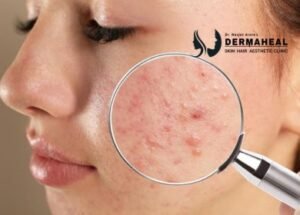
Acne can clear, but the scars left behind may remain for months or even years. If you have pits, depressions, uneven texture, or visible marks after acne, you may be wondering: Which acne scar treatment is right for my skin?
The answer depends on the type of scar you have. Rolling scars, boxcar scars, ice-pick scars, and tethered scars have different structures, so they may need different treatment approaches.
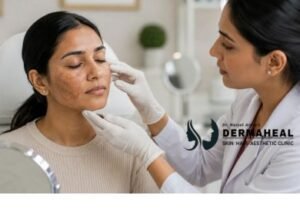
If you are considering acne scar treatment in Dwarka, the first step is to have your skin assessed by a dermatologist. Identifying the scar type, skin condition, and whether active acne is still present can help determine a suitable treatment plan.
What Are Acne Scars?
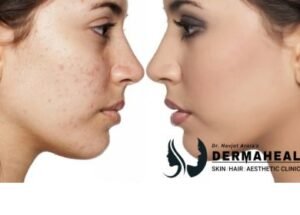
Acne scars are changes in the skin that remain after acne heals. They can develop when inflammation from acne affects deeper layers of the skin and interferes with normal collagen production during healing.
Common acne scars include:
- Rolling scars: Wider, shallow depressions that can make the skin look wavy or uneven.
- Boxcar scars: Round or oval depressions with clearer, defined edges.
- Ice-pick scars: Narrow and deeper scars that look like small pits.
- Tethered scars: Depressed scars that are attached to deeper tissue underneath the skin.
- Raised scars: Areas where scar tissue becomes elevated rather than depressed.
It is also important to understand the difference between acne marks and acne scars.
A flat brown, red, or dark area after a pimple is usually a pigmentation mark. A change in skin texture, such as a depression or raised area, is more consistent with a scar.
This distinction matters because pigmentation and structural acne scars may require different treatment approaches.
Which Acne Scar Treatment Is Right for Your Skin?
There is no single procedure that is suitable for every acne scar.
The right approach depends on the scar type, depth, skin condition, active acne, and treatment goals. Dermatologists may also combine treatments when a person has more than one type of scar. The American Academy of Dermatology notes that individualized treatment plans and combination approaches are commonly used for acne scars.
At Dermaheal Skin & Hair Clinic in Dwarka, the current acne scar reduction protocol uses different techniques according to scar type, including MNRF, subcision, and TCA-CROSS.
1. MNRF for Rolling and Some Boxcar Scars
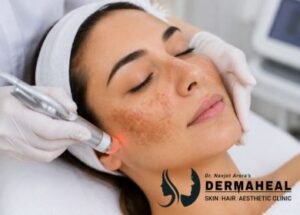
MNRF, or microneedling radiofrequency, combines microneedling with radiofrequency energy.
The treatment creates controlled micro-injuries while delivering radiofrequency energy into targeted skin layers. This can support collagen remodelling and help improve uneven skin texture.
MNRF may be considered for certain rolling and boxcar acne scars, depending on their structure and depth.
Dermaheal lists MNRF as part of its acne scar protocol for rolling and boxcar scars.
The important point is that MNRF should not simply be selected because it is a popular treatment. A dermatologist should first determine whether your scar pattern is appropriate for it.
2. Subcision for Tethered Acne Scars
Some depressed acne scars are held down by fibrous bands beneath the skin. These are often described as tethered scars.
Subcision is a procedure designed to release these attachments beneath selected scars. Releasing the tether can allow the depressed area to become less noticeable.
Subcision may be used alone or combined with another treatment depending on the scar pattern.
Dermaheal includes subcision in its acne scar reduction protocol for tethered atrophic scars.
Because subcision involves working below the skin surface, it should be performed by an appropriately trained medical professional.
3. TCA-CROSS for Ice-Pick Scars
Ice-pick scars are narrow and deep. Because of their structure, they may require a more targeted treatment.
TCA-CROSS involves controlled application of trichloroacetic acid to selected deep scars. It is intended for appropriate individual scars rather than being used as a conventional full-face chemical peel.
Dermaheal currently includes TCA-CROSS in its acne scar protocol for deep ice-pick scars.
Whether this treatment is appropriate depends on your scar type and skin assessment.
4. Microneedling for Acne Scars and Uneven Texture
Microneedling uses fine needles to create controlled micro-injuries in the skin. This stimulates the body’s natural healing response and collagen production.
It can be considered for certain acne scars and uneven skin texture. The American Academy of Dermatology notes that microneedling can improve the appearance of acne scars and may be combined with other treatments, including radiofrequency.
Dermaheal also offers Dermapen microneedling for acne scars and uneven skin texture. Its current treatment page describes a dermatologist-led protocol with several sessions and progressive improvement.
5. Fractional Laser for Selected Acne Scars
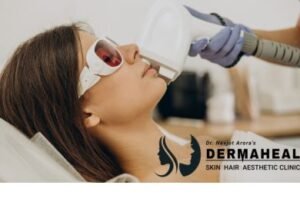
Fractional laser resurfacing is another option that may be considered for selected acne scars and uneven skin texture.
Laser treatment creates controlled treatment zones in the skin and can stimulate collagen production during the healing process. The AAD lists laser treatment among professional options for reducing the appearance of depressed acne scars.
However, laser treatment is not automatically appropriate for everyone.
Your dermatologist should consider factors such as:
- Scar type and depth
- Skin tone
- Previous pigmentation
- Active acne
- Previous procedures
- Recovery expectations
For Indian skin, careful treatment selection and settings are particularly important when there is a risk of post-inflammatory pigmentation.
Can One Treatment Treat All Acne Scars?
Usually, no.
Acne scars have different structures. A rolling scar is different from an ice-pick scar, while a tethered scar may need treatment that addresses the attachment underneath the skin.
This is why combination treatment may sometimes be used.
For example, one person may have rolling scars combined with a few deep ice-pick scars. Treating both areas with exactly the same procedure may not address their different structures.
Dermaheal’s current protocol uses scar mapping to identify the type of scar and then combines MNRF, subcision, and TCA-CROSS where indicated.
Should Active Acne Be Treated Before Acne Scars?
In many cases, yes.
If you continue to develop inflamed pimples, cysts, or other active acne, controlling the breakouts is an important part of preventing additional scarring.
Dermaheal’s acne programme states that active breakouts are managed first before targeted protocols are used for scars and dark spots.
This means your treatment plan may begin with acne control before moving to more intensive scar treatment.
Treating the existing scars while new acne continues to form may make it harder to maintain long-term improvement.
How Many Sessions Are Needed for Acne Scar Treatment?
There is no fixed number of sessions that applies to everyone.
The treatment course can depend on:
- Scar type
- Scar depth
- Number of scars
- Skin condition
- Treatment selected
- Response to treatment
- Whether combination procedures are needed
Dermaheal currently lists a minimum of 5–7 sessions for its acne scar reduction protocol, with a listed downtime of approximately 3–5 days. This is the clinic’s protocol and should not be considered a universal requirement for every patient.
Your dermatologist can provide a more relevant treatment schedule after examining your skin.
Can Acne Scars Be Completely Removed?
Acne scar treatment generally aims to reduce the appearance of scars and improve skin texture, rather than promise complete removal.
The amount of improvement varies between individuals. Deeper, older, or more complex scars may require multiple sessions or more than one treatment technique.
Collagen remodelling can also continue after certain procedures, so improvement may develop gradually rather than immediately. Dermaheal states that collagen remodelling can continue for several months following its acne scar protocol.
A realistic treatment plan should focus on progressive improvement rather than promising perfect skin overnight.
How Can You Prevent New Acne Scars?
Preventing new scars starts with controlling acne early.
Helpful habits include:
- Avoid squeezing or picking pimples.
- Treat persistent acne rather than ignoring it.
- Follow a skincare routine suitable for your skin.
- Protect your skin from excessive sun exposure.
- Avoid aggressive DIY procedures.
- Follow your dermatologist’s post-treatment instructions.
- Seek professional care if acne continues to return.
The goal is not only to improve existing scars but also to reduce the chance of developing new ones.
When Should You See a Dermatologist for Acne Scars?
Consider a dermatology consultation if:
- Acne scars have remained for several months.
- Your cheeks, temples, forehead, or jawline have uneven texture.
- You have visible pits or depressions.
- You have rolling, boxcar, or ice-pick scars.
- You have both active acne and old scars.
- You cannot tell whether you have acne marks or true scars.
- Home skincare has not produced the improvement you want.
A dermatologist can examine the skin and determine whether the main concern is active acne, pigmentation, structural scarring, or a combination.
Acne Scar Treatment in Dwarka: Why Personalised Assessment Matters
If you are searching for acne scar treatment in Dwarka, it can be tempting to select a procedure based only on social media, advertisements, or before-and-after photographs.
Instead, start by understanding your scar type.
At Dermaheal Skin & Hair Clinic in Dwarka, the current acne scar reduction approach matches treatment techniques to individual scar types, including MNRF for rolling and boxcar scars, subcision for tethered atrophic scars, and TCA-CROSS for ice-pick scars.
This type of assessment can help determine whether one procedure or a combination approach is appropriate for your skin.
Frequently Asked Questions
1. What is the best treatment for acne scars?
There is no single treatment that is suitable for everyone. The appropriate option depends on the scar type, depth, skin condition, and whether active acne is still present.
2. Is MNRF good for acne scars?
MNRF may be considered for certain rolling and boxcar acne scars. A dermatologist should assess the scar structure before deciding whether radiofrequency microneedling is appropriate.
3. Which treatment is used for ice-pick acne scars?
Ice-pick scars are narrow and deep. TCA-CROSS is one treatment that may be considered for suitable ice-pick scars. Other options may also be considered depending on the individual assessment.
4. Should active acne be treated before acne scars?
In many cases, yes. Controlling active acne can help reduce the risk of developing additional scars while existing scars are being treated.
5. How long does acne scar treatment take?
The timeline varies according to scar type, treatment, and individual response. Some people need multiple sessions, while others may require a combination of procedures. A dermatologist can provide a personalised treatment plan after examining your skin.
Suggested Links
https://dermaheal.co.in/#contact
https://dermaheal.co.in/gallery
https://dermaheal.co.in/results
Take the Next Step Towards Smoother Skin
Acne scars are not all the same, so choosing a treatment should begin with proper scar assessment, not simply selecting the most popular procedure.
If you are looking for acne scar treatment in Dwarka, consult a dermatologist to understand your scar type and discuss which treatment or combination of treatments may be suitable for your skin.
Visit Dermaheal Skin & Hair Clinic in Dwarka
Dermaheal Skin & Hair Clinic
C-712, Ramphal Chowk, Block D, Sector 7 Dwarka, Palam, near Shiksha Bharti School, New Delhi 110075
Call: +91 80809 10191 / +91 73794 64999
Clinic Hours:
Monday to Saturday: 10:00 AM – 7:30 PM
Sunday: 10:00 AM – 7:00 PM
Book your consultation today and get a dermatologist-led assessment of your acne scars before choosing a treatment.